


In This article
- Higher exposure to adverse childhood experiences was associated with a higher lifetime prevalence of physician-diagnosed PCOS/PMOS.
- The prevalence of PCOS increased with the number of adverse childhood experiences reported.
- Several types of childhood adversity, including sexual abuse, parental interpersonal violence, and emotional and physical abuse, were associated with higher PCOS prevalence.
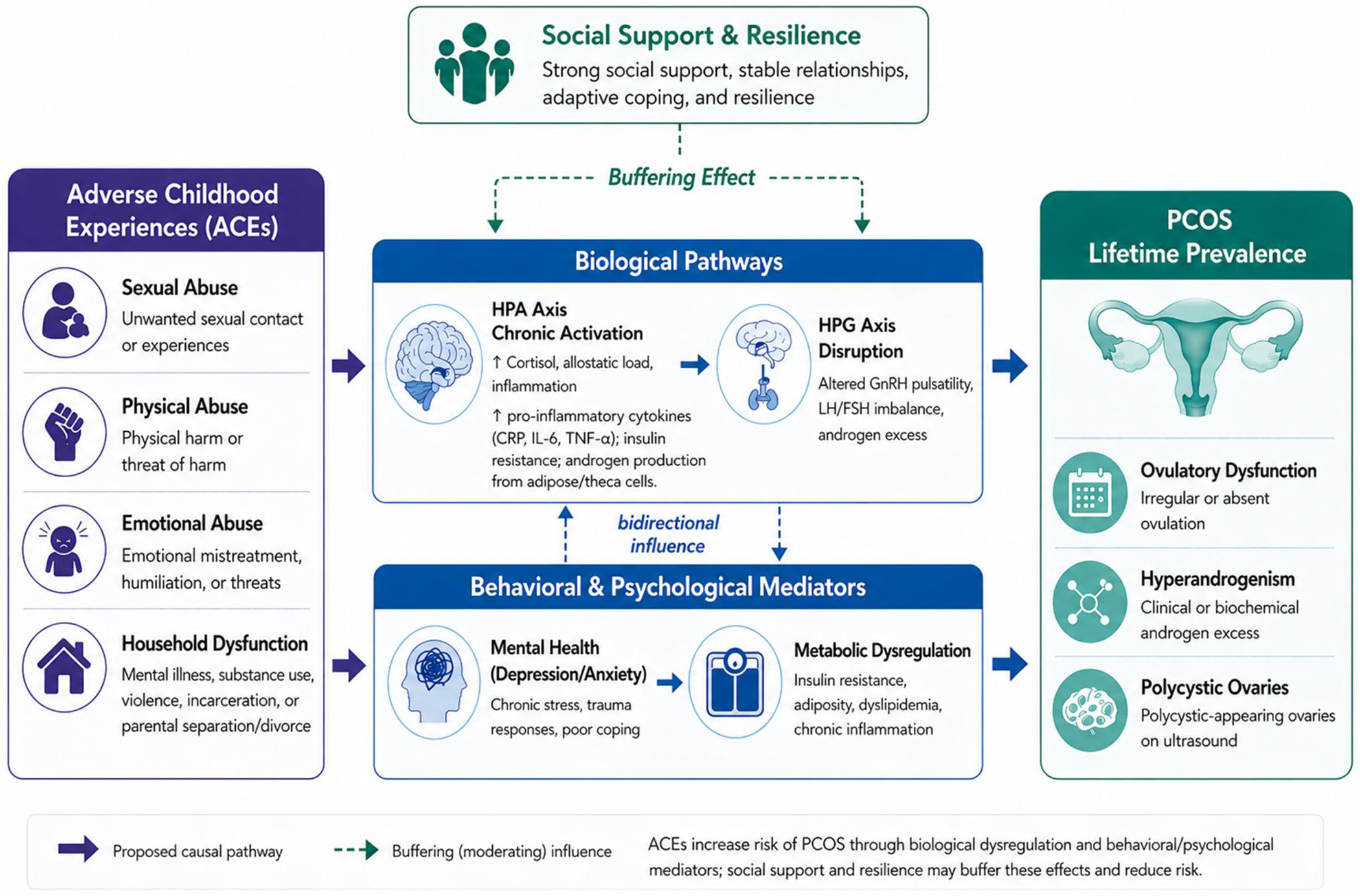
- Researchers hypothesize that childhood adversity may affect reproductive health through interconnected stress-response and reproductive systems, including the HPA and HPG axes.
- Because this was a cross-sectional study, the findings demonstrate an association but do not establish that childhood adversity causes PCOS/PMOS.
Adverse childhood experiences (ACEs) are common and have been associated with a range of adverse long-term health outcomes, including mental health conditions, cardiometabolic disease, and other chronic health problems. Increasingly, researchers are examining whether exposure to significant stress or adversity during childhood may also influence reproductive health later in life.
A recent study from Wise and colleagues explores the relationship between childhood adversity and polycystic ovary syndrome (PCOS), recently renamed polyendocrine metabolic ovarian syndrome (PMOS). Researchers have hypothesized that chronic or severe stress experienced during childhood may alter the development and regulation of the hypothalamic-pituitary-adrenal (HPA) axis, as well as the hypothalamic-pituitary-gonadal (HPG) axis. Alterations in these interconnected systems could potentially affect ovarian function, menstrual cyclicity, androgen production, and metabolic regulation.
There is preliminary evidence supporting a relationship between childhood adversity and PCOS/PMOS, although the available literature is limited. The current study adds to this literature by examining the relationship between a broad range of adverse childhood experiences and physician-diagnosed PCOS/PMOS in a large North American cohort.
Study Design
In this study, researchers used cross-sectional data to evaluate the association between early life adversities and self-reported, physician-diagnosed polycystic ovary syndrome in participants of the Pregnancy Study Online, a prospective cohort study designed to study risk factors for delayed conception, miscarriage, and adverse birth outcomes. This cohort includes North American females between the ages of 21 and 45 years.
At enrollment, participants completed a baseline questionnaire providing information on sociodemographic variables, behavioral factors, and medical history. Thirty days after enrollment, participants completed a supplemental questionnaire that included the Behavioral Risk Factor Surveillance System’s 8-item adverse childhood experience module and the Brief Trauma Questionnaire.
Participants reported physician-diagnosed polycystic ovary syndrome on baseline and follow-up questionnaires during preconception.
Study Findings
The study included 10,856 participants:
- Adverse childhood experiences: 52% reported 1 to 3 ACEs, and 26% reported 4 or more adverse childhood experiences.
- PCOS: 1,169 (10.8%) reported a physician-confirmed diagnosis of polycystic ovary syndrome.
The prevalence of PCOS ranged from 7.4% in women with no adverse childhood experiences to 14.2% in those who experienced 4 or more adverse childhood experiences.
After adjusting for age, race, ethnicity, childhood financial hardship, and highest level of parental education, the prevalence ratio of PMOS was 1.33 for 1 to 3 ACEs (95% CI, 1.11-1.60) and 1.64 for 4 or more ACEs (95% CI, 1.33-2.01), compared to those with no ACEs.
Prevalence ratios of PCOS/PMOS varied by the type of ACE. Specific adverse childhood experiences associated with the largest increase in PCOS prevalence included:
- Sexual abuse (prevalence ratio or PR = 1.82; 95% CI, 1.45-2.29)
- Parental interpersonal violence (PR = 1.68; 95% CI, 1.29-2.17)
- Emotional abuse (PR = 1.54; 95% CI, 1.28-1.86)
- Physical abuse (PR = 1.52; 95% CI, 1.21-1.90)
- Household mental illness (PR = 1.46; 95% CI, 1.21-1.77)
- Parental separation/divorce (PR = 1.43; 95% CI, 1.15-1.77)
Understanding the Connection Between Childhood Adversity and PMOS
In this North American cross-sectional study, higher exposure to early life adversities was associated with a higher lifetime prevalence of self-reported, physician-diagnosed PCOS/PMOS. Sexual abuse showed the strongest positive association with PCOS, followed by parental interpersonal violence, emotional abuse, and physical abuse.
Individuals with first exposure to physical or sexual abuse as a child were more likely to be diagnosed with PCOS than those with first exposure as a teen. However, exposure to sexual abuse as a child and as a teen was associated with greater prevalence of PCOS.
These findings add to growing evidence that childhood adversities may have lasting effects on reproductive health and underscore the need for attention to early life stressors in understanding polycystic ovary syndrome.
Researchers hypothesize that early life adversity may influence reproductive health through changes in interconnected stress-response and reproductive systems. In particular, childhood adversity may affect the HPA and HPG axes, potentially influencing ovarian function, menstrual cyclicity, androgen production, and metabolic regulation. The following diagram included in the article illustrates the complex interactions between these systems.
It is important to note that this was a cross-sectional study, so the findings demonstrate an association between childhood adversity and PCOS/PMOS but do not establish that childhood adversity causes PCOS/PMOS. The study also relied on self-reported physician-diagnosed PCOS/PMOS.
Overall, the findings suggest a relationship between exposure to adverse childhood experiences and the likelihood of having PCOS/PMOS. Further research will be needed to better understand the mechanisms underlying this association.
—Ruta Nonacs, MD PhD