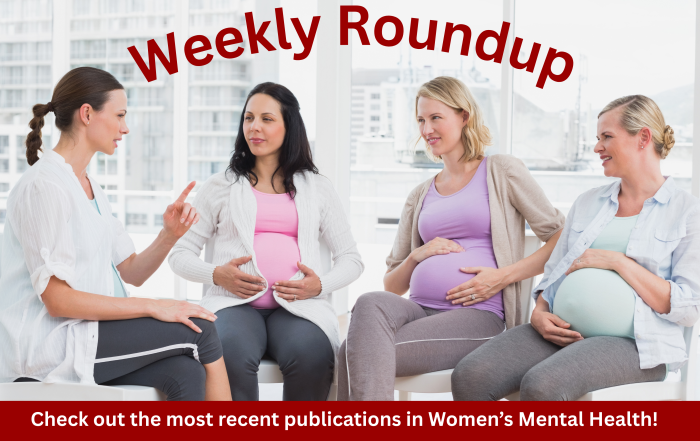



Every week we review the most recent publications in women’s mental health, covering topics related to premenstrual symptoms, perinatal mood and anxiety disorders, use of medications in pregnant and breastfeeding women, perinatal substance use, and menopausal mental health.
To receive more detailed descriptions of many of these topics delivered straight to your email, you can sign up to receive our weekly CWMH NEWSLETTER which comes out every Thursday.
Happy Reading!
Ruta Nonacs, MD PhD
PMS AND PMDD
No articles this week
INFERTILITY AND MENTAL HEALTH
Impact of a 12-week Yoga Intervention on Seminal Oxidative Stress, Sperm Quality, and DNA Fragmentation Index in Infertile Men: A Pre-post Intervention Study.
Regular yoga practice significantly improves sperm function and reduces oxidative stress and DNA damage in infertile men. These findings support yoga as a beneficial adjunct therapy for the management of unexplained male infertility and can potentially enhance fertility outcomes.
PSYCHIATRIC ILLNESS DURING PREGNANCY
SARS-CoV-2 Infection During Pregnancy Not Linked to Early Neurodevelopmental Delay.
Children with prenatal exposure to SARS-CoV-2 showed no meaningful differences in early developmental or social-emotional outcomes compared with unexposed children through 18 months of age.
Depression Surrounding Pregnancy Treated With Interpersonal Therapy: Researcher Insights from a Randomized Clinical Trial.
In this RCT, 234 pregnant individuals with elevated depressive symptoms were randomized to receive brief IPT versus enhanced usual care. Brief IPT produced faster, larger antenatal symptom improvement and lowered MDD prevalence from 37% at entry to 6% during pregnancy.
Prenatal Exposures Linked to Altered Developmental Psychopathology in Adolescence.
Adverse prenatal exposures are linked to persistent childhood psychopathology and accelerated cortical thinning in adolescence.
MEDICATIONS AND PREGNANCY
Prescription stimulant continuation in pregnancy and birth outcomes.
Hasan SA, Murugappan M, Westberg S, et al. J Atten Disord. Published online December 16, 2025.
Although early stimulant exposure was not associated with increases in maternal or fetal risk, continuation of stimulants into trimesters 2 and/or 3 may increase some pregnancy complications including stillbirth, preterm birth, hypertensive disorders of pregnancy, and placental abruption.
POSTPARTUM PSYCHIATRIC ILLNESS
No articles this week
MEDICATIONS AND BREASTFEEDING
No articles this week
PERINATAL SUBSTANCE USE
Cannabis Use During Pregnancy Correlates With Adverse Maternal Mental Health Outcomes: A Retrospective Study.
Cannabis use during pregnancy was associated with markedly higher risks of alcohol abuse, suicidal ideation, panic disorder, and depression, with nearly 30% of cannabis users experiencing depression versus 11.2% of non-users.
The impact of cannabinoids on reproductive function.
REVIEW ARTICLE: This review summarizes the effects of pre- or peri-conceptual exposure to cannabinoids on female and male reproductive function, along with pregnancy outcomes from 2014 to 2024.
Maternal Prenatal Cannabis Use and Major Structural Birth Defects.
Maternal prenatal cannabis use was linked to increased risk of gastroschisis and omphalocele, though these defects were rare, and no associations were found with other birth defects.
Investigating Links Between Prenatal Cannabis Exposure and Brain Development Using Magnetic Resonance Imaging Techniques: A Narrative Review.
REVIEW ARTICLE: This narrative review describes neuroimaging studies of prenatal cannabis exposure, suggesting potential alterations in brain structure and connectivity, particularly in frontal, parietal, and temporal regions, while emphasizing the need for more research.
From card to cradle: examining medical cannabis purchasing among pregnant women in Arkansas.
The mean daily THC dose purchased by pregnant women exceeded therapeutic dosing ranges for approved cannabinoid formulations in nonpregnant adults, especially among those initiating medical cannabis before pregnancy.
Racial Equity in Urine Drug Screening Policies in Labor and Delivery.
Black pregnant patients were significantly more likely than White patients to undergo peripartum urine drug screening and reporting to child protective services; removing isolated cannabis use and limited prenatal care as screening indications, plus decision support, improved racial equity in testing and reporting.
MATERNAL MENTAL HEALTH AND CHILD OUTCOMES
The effects of a second pregnancy on women’s brain structure and function.
During a second pregnancy, similar but less pronounced changes in default mode and frontoparietal networks were observed, with stronger alterations in dorsal attention and somatomotor networks; neurostructural changes in both parity groups related to mother–infant attachment and vulnerability to peripartum depression.
Breastfeeding moderates the association between family socioeconomic status and child behavior scores.
In low-SES families, longer and more exclusive breastfeeding was associated with fewer child behavior problems and a smaller socioeconomic gap in behavior scores, though unmeasured protective factors likely also contribute.
MENOPAUSE AND MENTAL HEALTH
The Impact of Estradiol Dynamics During the Menopause Transition on Depression Risk: a narrative review of estradiol’s neurobiological mechanisms.
REVIEW ARTICLE: This narrative review outlines how fluctuating estradiol levels across the menopause transition modulate neurobiological processes that increase risk for depressive symptoms and perimenopausal-onset major depressive episodes.
Eight-session manualized cognitive behavioral therapy for anxiety and depression symptoms in perimenopause and postmenopause: a pilot study.
A standardized, non–menopause-specific CBT protocol reduced depressive and anxiety symptoms in a small cohort of women in perimenopause and postmenopause.