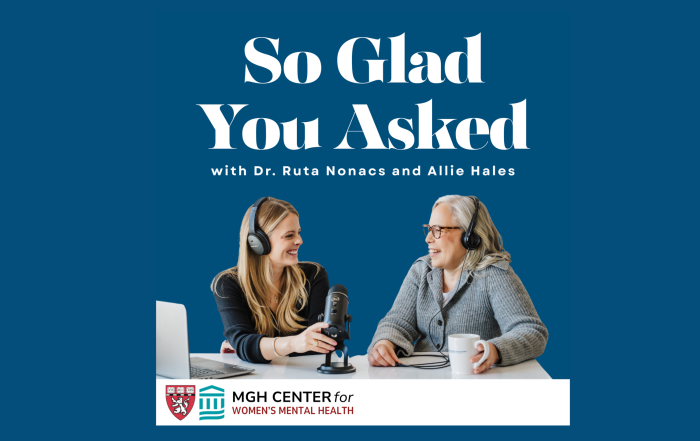
For this week’s episode of So Glad You Asked with Dr. Ruta Nonacs and Allie Hales, we sit down with Jessica Vernon, MD and Marlene Freeman, MD to discuss depression and anxiety during pregnancy and how to improve care for women in this setting.
It is estimated that up to 20% of women experience a perinatal mood or anxiety disorder (PMAD), yet many remain undiagnosed and untreated. In 2015, the American College of Obstetricians and Gynecologists (ACOG) recommended universal screening for depression and anxiety during pregnancy and the postpartum period. The use of standardized screening tools such as the Edinburgh Postnatal Depression Scale (EPDS) have improved recognition; however, screening alone has not been sufficient to close this gap.
Women with PMADs continue to be underrecognized, undertreated, and often struggle to access appropriate care. Screening may help identify symptoms, but it does not replace the need for meaningful clinical engagement and follow-up.
In this week’s episode of our podcast So Glad You Asked, we sit down with Jessica Vernon, MD, and Marlene Freeman, MD, and discuss how we can move beyond screening to provide more comprehensive, patient-centered care during pregnancy and the postpartum period.
- Jessica Vernon, MD is a board-certified OB/GYN and Associate Medical Director at Oula whose work focuses on health equity and expanding access to perinatal mental health care.[oulahealth]
- Marlene Freeman, MD is a Professor of Psychiatry at Harvard Medical School, Associate Director of the Center for Women’s Mental Health at MGH and a leading researcher in perinatal mood disorders.
While the increasing use of screening tools represents progress, it also raises an important question: are we losing something essential in the process? In an increasingly medicalized model of prenatal care, opportunities for connection—simple but critical questions like “How are you doing?” or “What’s going on at home?”—may be overlooked.
Obstetric providers care deeply about their patients, yet many feel underprepared to address mental health concerns. Screening for perinatal depression and barriers to treatment, identification is only the first step; access to care and patient education are equally critical.
Drs. Vernon and Freeman emphasize the importance of educating both patients and providers, normalizing conversations around mental health, and creating systems of care that integrate obstetric and psychiatric expertise.
In this episode, we discuss:
- How to recognize when symptoms may indicate a mood or anxiety disorder
- How to initiate conversations with healthcare providers
- What to expect after screening positive for depression or anxiety
- How to find reliable information and access treatment for PMADs
- Considerations when evaluating treatment options, including medication use during pregnancy
Ultimately, improving outcomes for mothers and families requires a more holistic approach—one that addresses both the physical and mental health needs of patients throughout pregnancy and the postpartum period.
—Ruta Nonacs, MD PhD